
Bug Menu
click below for info
 Mites |
 Silverfish |
 Pill Bugs |
 Spiders |
 Termites |
 Ticks |
 Moths |
 Grain Beetles |
 House Flies |
 Wasps & Hornets |
 Mosqitoes |
 Scorpions |
- Spiders
- Scorpions
- Cockroaches
- Termites
- Carpenter Ants
- Odorous Ants
- Rats & Rodents
- Wildlife Removal
- Free Inspections
- Treatments
- New Home Pre-Treatments
- About Us
- Contact Us
Vole Treatment, Service and Do-it-yourself info...
Toll Free: 1(800) 528-4373
Stateline: (775) 588-9800 Glenbrook & Carson City: (775) 749-5949 Incline Village: (775) 833-4455
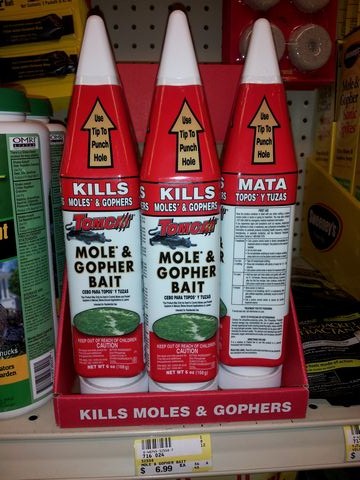
You
can buy this 6-ounce application of Vole Bait for $6.99 (plus tax) at
your local store.
However, you would have to buy
13 of these tubes to
equal the Typical
5-Pound application that we apply (with our experience and
expertise) when we treat for Voles (note: this is based on an average
size yard).
That means you would have to spend almost $100.00 and then apply the treatment
yourself, just to
equal the treatment that we expertly apply for about the same amount...
Even if you are a do-it-yourself person, wouldn't you rather save some
money and have the peace of mind knowing your Vole Treatment was
applied by experts with years of experience treating vole infestations?
~ The following is a brief overview of Vole habits and common problems,
and
our usual Terms of Service with respect to them ~
A Few Vole Facts…
Voles are small, weighing only 1 to
2 ounces as adults. There are several different species and they will
differ in color, general size and relative length of tail, but it
usually isn’t necessary to distinguish between the species to control
the damage they cause.
The breeding season for all voles encompasses most of the year with
peaks occurring in the spring and fall (one captive meadow vole had 17
litters during one year, totaling 83 young. A female from that first
litter had 13 litters, totaling 78 young before turning 1 year old!)
Many vole populations are cyclic and can increase from only a dozen per
acre to several hundred voles per acre. In North America, vole
populations peak about every four years. These cycles are not regular
however and they often result in severe crop damage and of course
significant damage to lawns, shrubs, perennials and landscaped areas.
Voles are active day and night, year-round. They do not hibernate. Home
range is usually 1/4 acre or less and varies with season, population
density, habitat, food supply, etc.
Voles are semifossorial and construct many tunnels and surface runways
with numerous burrow entrances.
A single burrow system may contain several adults and young!
Voles can thrive under forest litter and in fields surrounding timber
stands.
Vole damage is costliest during the winter when a shortage of
preferable foods forces them to eat the inner green bark layer of trees
and shrubs. The gnawing required to reach this layer can severely
damage or kill many young trees, shrubs, and landscape plantings
The vole damage manifests itself several ways. Sometimes it looks like
wavy paths of dead grass about 2 inches wide. More often, the paths
become little ditches of bare inch deep. The devastation can be
extensive.
And there’s more bad news. When the snow melts, the voles don’t go
away. They’re still on the property, living under mulch, in weedy
areas, or somewhere undercover hiding from their predators — cats,
hawks, and owls.
Voles are vegetarians and they can munch their way through a lot of
additional plants after damaging your lawn. So if you did suffer vole
damage on your lawn, keep an eye on your perennials this spring, if
they don’t come back, they were probably lunch for some voles. Tulips
planted last fall that don’t show up this spring were probably snacks.
Voles also love to dig down and eat the tender roots of newly planted
trees, shrubs, and flowers, so keep an eye on new transplants. The good
news is voles don’t eat daffodils
Warning signs seem to crop up overnight. Mulched areas around your yard
are riddled with intricate runways--as if someone traced a path with a
stick from shrub to shrub. Or maybe your ornamental plants are dying,
or there's damaged or missing bark around the base of trees.
Your first thought might be that you've got moles or gophers, but
chances are much higher your problem is the common vole.
Check bark damage carefully. If the bark was chewed under the snow, it
was probably mice or voles. If the damage occurred above the snow line,
it was probably rabbits. Mice and voles may chew at the snow line by
walking on the snow, but never above the snow. They will not chew off a
branch of a young tree as a rabbit does.
Now that you are armed with information, you need to decide how you
would like to proceed?
We recognize that a control program may not appear to be justified in
comparison to the damage being incurred. However, the “ounce of
prevention” rule certainly applies in Vole control… Preventive control
measures that at first appear too costly will in fact prove to be a
bargain.
For customers who desire to be proactive and take measures against
voles, our service plan is as follows:
Service is monthly, usually beginning in April/May and extending
through Oct/Nov.
We do find that this is sufficient for
the majority of our customers unless there are extenuating
circumstances… Such as…
Neighboring homes, property or vacant land that have a strong vole
presence.
If the landscaping around your home is full of delicious items that
provide a draw for these rodents… In other words, we may killing dozens
of them, but the buffet you are providing them with your landscpaing is
hard to resist…
(Note: we understand the desire for the presence of extravagant
colorful and out of the ordinary plants in your landscaping, however
you may want to consider more native plants that do not present such a
delicious buffet for the Voles…)
If you “must have” an out of the ordinary yard, we CAN IN FACT HELP,
however it may in fact take a more frequent service interval (e.g.
weekly or every-other week service), the service fees for these follow
up visits will be based on the amount of material applied to the
runways, burrows, etc.
In conclusion, each home is different and we are happy to discuss
prices further with you.
However we do not have a crystal ball and we have no way of knowing in
advance how “infested” your landscaping is (or that of your immediate
neighbors) as such we can make no warranty with respect to the outcome
of your individual case. However, please also know that we do share
the same goal as you. We are striving to create a vole-free yard so
that you can enjoy it without the frustration associated with voles.
(Note: references are available).
If you would like to take action to protect your lawn, shrubs and
garden from these predators,
Please call Lakeside Termite and Pest Control:
800-528-4373